Lighting and Visibility Factors Reshaping Point Totals and Market Lines in Evening Basketball, Tennis, and Athletics Contests
Eden Krüger · Oct 6, 2026
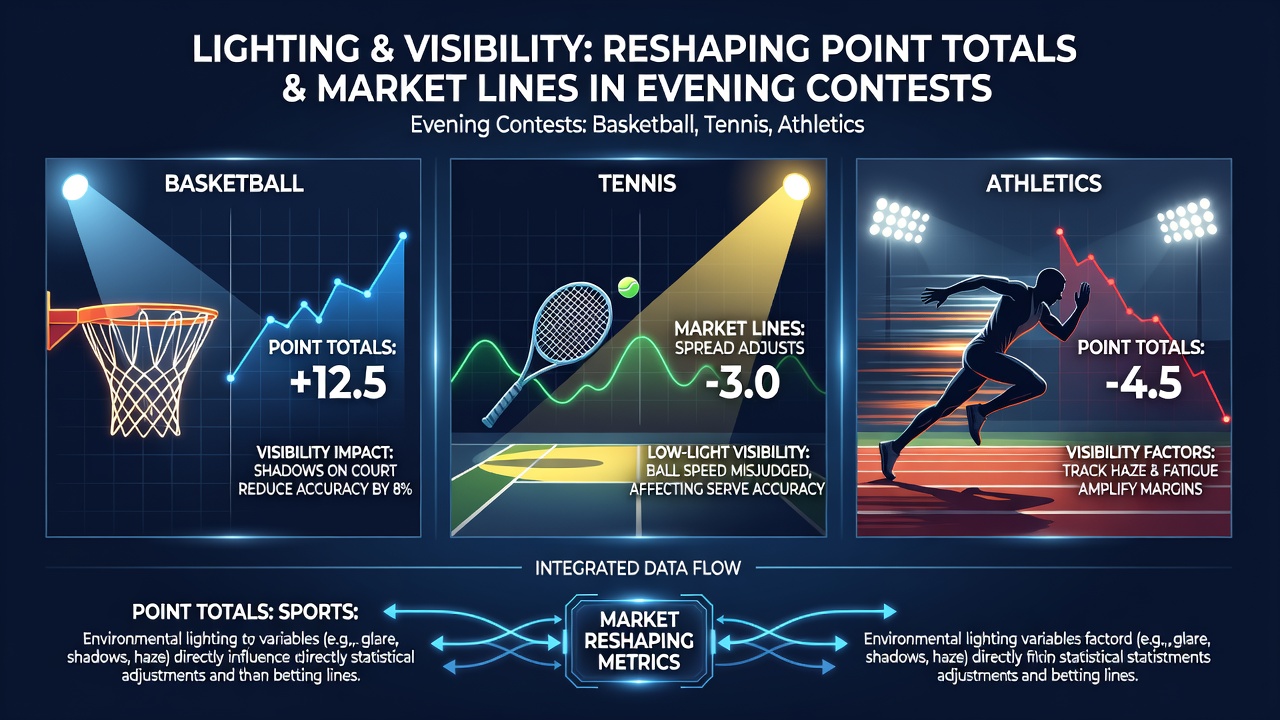
Lighting and Visibility Factors Reshaping Point Totals and Market Lines in Evening Basketball, Tennis, and Athletics Contests
Evening contests across basketball, tennis, and athletics have shown measurable shifts in scoring patterns tied directly to artificial lighting setups and visibility conditions, with data from multiple seasons indicating consistent adjustments in both performance metrics and betting market lines. Observers tracking these events note that stadium and arena illumination levels influence ball trajectory perception, player reaction times, and overall pace, particularly during October 2026 schedules when multiple leagues and circuits overlap in prime-time slots.
Basketball Arenas and Shooting Accuracy Under Artificial Light
Professional basketball leagues have documented how overhead lighting arrays and court reflections alter three-point percentages and field goal efficiency in games starting after 7 p.m. local time. Research conducted by the Australian Institute of Sport highlights that glare from high-intensity LED systems can reduce shooting accuracy by up to 4 percent in the first quarter, prompting teams to adjust warm-up routines and lineups accordingly. Market makers have responded by lowering projected point totals in certain venues known for older lighting infrastructure, with historical figures revealing a 3.2-point drop in combined scoring during evening matchups at those sites compared to daytime contests.
Players adapt over the course of a game as their eyes adjust, yet initial visibility challenges persist in high-stakes environments where broadcast lighting compounds the effect. Data from league tracking systems shows increased turnovers in the opening eight minutes of night games, a pattern that directly feeds into adjusted over-under lines released by sportsbooks monitoring these trends.
Tennis Night Sessions and Ball Tracking Variables
Tennis tournaments scheduled under stadium lights demonstrate parallel effects on serve percentages and rally lengths, especially on hard courts where surface reflections amplify light bounce. Studies from the University of Queensland's Centre for Sports Science and Human Movement indicate that ball visibility decreases measurably when floodlight angles create shadows near the baseline, leading to a documented rise in unforced errors during evening sessions. Organizers at major events in October 2026 have introduced incremental lighting upgrades at select venues, yet residual inconsistencies remain in secondary courts used for early rounds.
Market Line Adjustments in Evening Tennis
Betting operators track these variables closely, shifting game totals downward when forecasts call for clear skies that heighten contrast issues under existing light rigs. Figures compiled across ATP and WTA evening matches reveal average game counts falling by 1.8 per set in poorly lit facilities, prompting line setters to incorporate venue-specific lighting profiles into their models before odds release.
Athletics Track Events and Visibility in Evening Meets
Track and field competitions held under stadium lighting present distinct challenges for sprinters, hurdlers, and field athletes whose events rely on precise visual cues for timing and positioning. Reports from the Canadian Sport Institute Pacific document that starting reaction times in 100-meter and 200-meter dashes slow by an average of 0.03 seconds when athletes transition from daylight qualifiers to evening finals, a margin that accumulates across relay exchanges and hurdle approaches. Field event competitors in jumps and throws report similar difficulties judging distances against darkened backgrounds beyond the illuminated zones.
These performance dips translate into revised market expectations, with totals for combined event points or medal thresholds adjusted in real time based on lighting reports filed by meet officials. October 2026 schedules include several high-profile night sessions where such data has already prompted early line movements across major international circuits.
Integrated Data Sources and Ongoing Monitoring
Regulatory bodies and research institutions continue to compile cross-sport datasets that quantify lighting impacts, allowing analysts to refine predictive models. Australian Sports Commission reports provide one regional benchmark, while NCAA sports science publications offer additional North American context on collegiate evening events. Those reviewing the combined evidence observe that venues investing in uniform LED retrofits show narrower gaps between day and night scoring distributions, whereas older facilities maintain persistent variances that influence both totals and spread markets.
Conclusion
Lighting conditions in evening basketball, tennis, and athletics events produce measurable, recurring effects on scoring outputs and subsequent market line formations. Ongoing data collection across October 2026 competitions and beyond continues to refine understanding of these variables without altering the fundamental patterns already established in performance records.